Gas Stove Keeps Clicking? Burner and Oven Igniter Problems and When to Call
A gas stove that keeps clicking usually has moisture or food around the burner, a burner cap that is not seated flat, or a dirty electrode. Clicking with every knob off most often means water in the burner switches behind the knobs. If the burners are clean and dry and the clicking goes on, the range needs service. A gas oven that takes far longer than usual to heat often has a weak igniter.
Updated November 23, 2026
Quality Service for Major & Luxury Brands































You turn the knob, the burner lights, and the clicking goes on anyway. Or the clicking starts with every knob turned off and will not quit. Or the oven takes much longer to preheat than it used to.
All three come from the same small system. A gas cooktop lights each burner with a spark, and most gas ovens light with a hot glowing igniter. Here is how it works, what to check first, what is safe to try at home in Thousand Oaks or anywhere else, and when the job needs a technician. The steps follow the manufacturers' own support pages, listed at the end.
How a gas burner lights, and which clicking is normal
When you turn a burner knob to Lite, a small switch behind the knob sends power to the electrodes. Each pulse jumps from the electrode to the burner as a spark, and that spark is the click you hear. Gas flows to that burner at the same time, the spark lights it, and the clicking should stop once you turn the knob past Lite to a flame setting.
Some clicking is normal:
- All burners click at once. On most ranges every burner sparks when any one knob is set to Lite, even though only the one you chose lights.
- Several clicks before the flame catches. It can take up to 10 or 12 clicks to light a burner.
- Short bursts while you cook. Many cooktops, including Wolf and Thermador models, have re-ignition. If a draft, a spill or a boil-over puts the flame out, the burner sparks again until it relights, then stops.
- Extra clicks after a burner sits unused. Air in the gas line can delay ignition. If the burner has not lit after about 10 seconds, turn it off, wait a minute and try again.
Clicking that continues with a steady flame, or that starts with no knob turned, is not normal.
Why a gas stove keeps clicking after the burner lights
This is the most common complaint, and the usual causes are simple.
- Moisture. Water from a spill, a boil-over or a fresh cleaning lets the spark leak away instead of lighting the gas cleanly. A wet burner keeps clicking until it dries out and its ports are clear. With the range off and cool, dry the caps and heads with a towel or let them air dry. Setting the removable parts in a warm oven for 30 minutes also works, and so does a hair dryer on its cool setting aimed at the burner and the knob shaft.
- A burner cap that is not seated. After cleaning, a cap or burner head that sits even slightly off center changes the gap to the electrode. Lift it off and set it back so it lies flat on its base. Some caps use alignment pins, so make sure they line up.
- A dirty electrode. Grease or burned food on the small ceramic electrode weakens the spark. Wipe the tip with a clean, dry paper towel or brush it gently with a soft toothbrush.
- Clogged burner ports. Food in the small holes around the burner keeps the flame from forming evenly. Manufacturers differ on the tool. GE suggests a needle or a paper clip, while Whirlpool calls for a straight pin and warns against a wooden toothpick or enlarging the holes. Follow your manual.
- A pan that is too big. An oversized pan can starve the burner of air and cause repeated sparking.
Gas pressure that is too high or too low can also cause repeated clicking. That is not an owner adjustment.
Clicking that will not stop, even with the knobs off
When the clicking runs with every knob off, the signal to spark is coming from a part, not from you.
- Water in a burner switch. Moisture in the switches behind the knobs, from cleaning or a spill, is the usual cause. Unplug the range and let it dry for a couple of hours or overnight.
- A switch that sticks. Check that each knob springs back from Lite. A switch that stays engaged keeps the electrodes sparking.
- A cracked or loose electrode. A cracked, broken or loose igniter needs service.
If the clicking still will not stop, turn off power to the range at the breaker or unplug it. Turn off the gas to the range as well until it is checked. With the power off the burners will not spark, so do not use the cooktop until it is repaired. Do not take the cooktop apart to reach the switches yourself.
If it keeps happening after the range has dried out, it needs service. On a Thermador or Viking range, a technician will test the switches, the wiring and the spark module before replacing anything.
Burner clicks but will not light
If you hear sparking but get no flame, start with the same basics. Make sure the knob is fully at Lite, since the igniter only lights gas in that position. Check that the cap and head are seated, the ports are clear and the burner is dry.
Two causes are easy to miss: a closed gas valve to the range, and moisture or debris on the heat sensing rod that some burners use. Air in the line on first use, a cooktop that locks itself after a power outage on some models, and a nearby downdraft vent can also stop a burner from lighting.
If only one burner fails and the rest light, the problem is at that burner. If none of them light, check whether other gas appliances in the home work. A burner that sparks but still will not light after cleaning needs service.
Gas oven slow to heat or not heating
Most gas ovens do not light with a spark. They use a hot surface igniter, a small part that glows bright orange as it heats. The igniter does two jobs. It is hot enough to light the gas, and the electric current flowing through it is what opens the oven's gas safety valve.
GE's technical data sheets for its gas ranges spell this out. The safety valve works on current, not voltage. It needs at least 2.9 amps to open, and a healthy igniter draws about 3.2 to 3.6 amps. A cold igniter needs 30 to 60 seconds of power before it draws that much. As an igniter ages it draws less, and GE's conclusion is that an igniter that glows but stays under 2.9 amps is usually the faulty part, not the valve.
That is why a glowing igniter is not proof that it works. A worn igniter can glow for a long time before the valve opens, which you notice as an oven that takes far longer to preheat than it used to, or one that glows and never lights. For a sense of normal, Wolf puts its gas ovens at 30 to 45 seconds to light, and up to a minute on a new unit.
Some gas ovens, mostly on newer ranges, light with a spark instead. Clicking in those ovens for more than 15 to 30 seconds without the burner lighting is not normal.
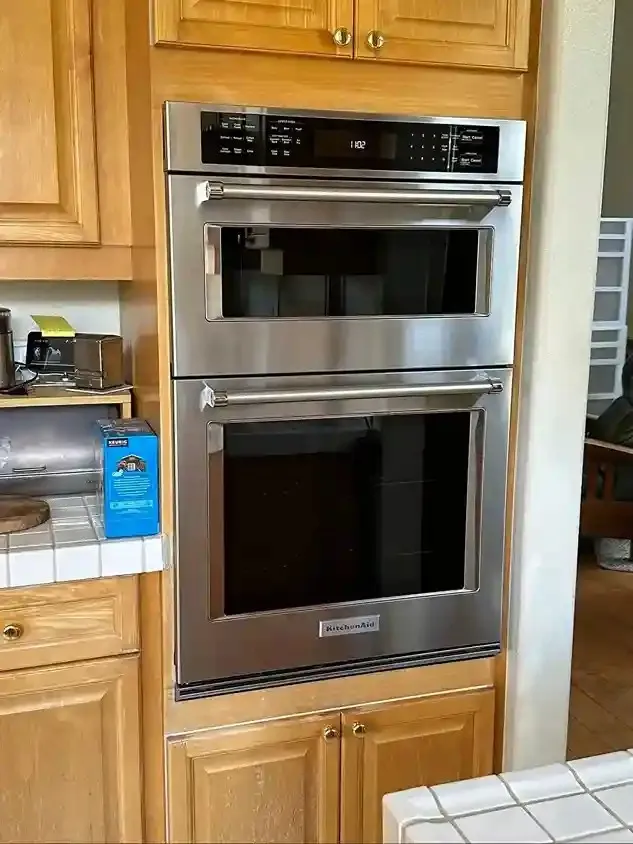
Measuring igniter current takes a meter and access behind live gas parts, so this is a job for a technician. Our oven and range repair page covers the brands we service, including KitchenAid.
When clicking or ignition becomes a safety issue
Gas flows only to the burner whose knob is turned on, while the other electrodes spark without gas. The danger is gas flowing without a flame, not the spark itself.
SoCalGas, the gas utility across Ventura County, says that if you smell gas, you should leave the area immediately and call its 24-hour line at 1-800-427-2200 from a safe place, or call 911 if lives or property are at risk. Do not turn lights or appliances on or off, do not use anything that could make a spark, and do not try to repair the leak.
Stop using a burner and call for service if a knob was on and the burner never lit, if you smell gas when the oven lights, or if the clicking will not stop after the range has dried.
What to check, step by step
Turn the burner off and let it cool
Never handle burner parts while the burner is on or hot.
Look for moisture and spills
If the cooktop was just cleaned or something boiled over, dry the caps and heads and give the switches a few hours to dry before deciding anything is broken.
Reseat every cap and burner head
Lift each cap off and set it back so it lies flat and centered on its base.
Clean the electrode and the ports
Wipe the electrode tip with a dry paper towel and clear blocked ports with the tool your manual names, usually a straight pin or a paper clip.
Check the knobs
Make sure each knob turns freely and springs back from Lite. A knob that sticks can keep the electrodes sparking.
Cut the power if clicking will not stop
Turn off the breaker or unplug the range, and turn off the gas to it, until a technician checks it.
Time the oven
If the oven takes much longer to light than it used to, or glows without lighting, book an igniter check.
When to call a technician
Call for service when the burners are clean, dry and seated and the clicking continues, when the clicking runs with every knob off after the range has dried, when a burner sparks but will not light, or when the oven takes far longer to heat than it used to. If you smell gas, call SoCalGas first.
Airtexno Appliance Repair answers the phone 24/7 at (805) 500-2705, offers same-day visits in most cases, and the service call is $95. You can also book through the contact page.
Repair or replace?
Ignition problems alone are rarely a reason to replace a range. Electrodes, burner switches, spark modules and oven igniters are separate parts that can be replaced on their own. As a market reference, HomeGuide lists gas oven igniter replacement at about $150 to $325 and gas stove igniter replacement at about $100 to $200, and Angi lists knob or switch replacement at about $75 to $150. Prices depend on the model and the part, so call for a quote after the diagnosis.
A professional-style range from Wolf, Thermador or Viking is almost always worth repairing, since the replacement cost is high and it is often fitted to the cabinetry. Replacement makes more sense when ignition trouble comes with other faults, such as a failing control board or a cracked cooktop. Repairs come with a workmanship warranty of up to one year.
Local notes: Thousand Oaks and Ventura County
Across Thousand Oaks, Newbury Park, Camarillo, Oxnard and Ventura, gas service comes from SoCalGas. Besides its 24-hour emergency line, SoCalGas offers a no-cost pilot relight and can perform a no-cost furnace safety check during that visit. Schedule it through your SoCalGas account. It covers pilots and gas safety, not cooktop parts, so a burner switch or oven igniter is still a job for an appliance technician.
If your cooktop has re-ignition, a short burst of clicking when a window or a sliding door is open, or when a pot boils over, is the feature doing its job. Steady clicking with a steady flame is not.
Oven, range and cooktop repair in Thousand Oaks and Ventura County
A diagnostic visit with a written estimate before any work. The $95 service call is credited toward the repair, with same-day availability in most cases.
See the repair pageSources: products.geappliances.com, products.geappliances.com, products.geappliances.com, producthelp.whirlpool.com, producthelp.whirlpool.com, producthelp.whirlpool.com, producthelp.whirlpool.com, producthelp.kitchenaid.com, samsung.com, lg.com, subzero-wolf.com, subzero-wolf.com, subzero-wolf.com, thermador.ca, manualslib.com, canadianappliance.ca, socalgas.com, socalgas.com, homeguide.com, angi.com
Frequently Asked Questions
Usually moisture, a cap that is not seated flat or a dirty electrode. Let the burner dry, reseat the cap and wipe the electrode. If it still clicks with a steady flame, call for service.
Most often water got into the switches behind the knobs during cleaning or a spill. Unplug the range and let it dry for a few hours or overnight. If the clicking returns, a switch needs service.
The clicking is an electric spark, and gas flows only to a burner whose knob is on. The danger is gas without a flame. If you smell gas, leave and call SoCalGas at 1-800-427-2200 or 911.
Many Wolf and Thermador cooktops relight a flame that a draft or a spill puts out, and the burner clicks until it relights. Constant clicking with a steady flame is a fault.
A weak glow igniter is a common cause. It can glow without drawing enough current to open the gas valve quickly. A technician measures the current to confirm it.
Wolf puts its gas ovens at 30 to 45 seconds to light, and up to a minute on a new unit. Check your manual, and call for service if yours takes much longer than it used to.
HomeGuide lists about $150 to $325 for a gas oven igniter replacement. The price depends on the model, so call for a quote after the diagnosis.